Bedding · Pillow guide
Healthy Choice Wool Pillows: Matching Loft and Care to Your Sleep Style
A pillow is a small object with an outsized job: it must fill the space between head and mattress without asking the neck to bend, twist, or hold itself rigid through the night. Wool changes the equation. It feels different from down and foam, responds differently under pressure, and asks for a more considered approach to cleaning. Understanding loft, sleep position, and upkeep can help you decide whether a wool pillow suits the way you rest.
Wool pillows are often chosen for their natural fill and breathable feel, but the fiber alone does not determine whether a pillow will be comfortable. The result depends on how much filling is inside, how it is layered, the dimensions of the pillow, the sleeper’s build, and the way the pillow changes with use. A pillow that feels lofty in a shop or just out of its packaging may settle as the filling compresses. One that feels supportive to a back sleeper may leave a side sleeper’s shoulder and neck poorly aligned.
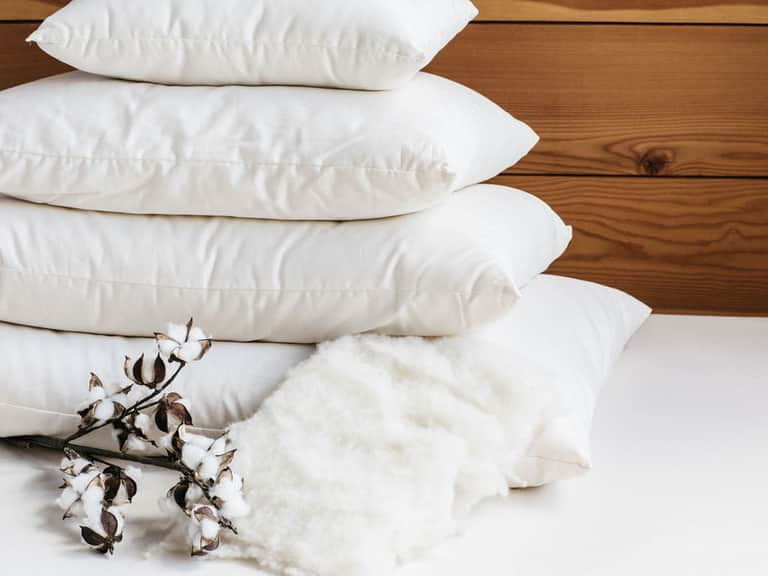
The Healthy Choice Organic Wool Pillow offers a useful reference point for thinking through those trade-offs. It is described as a fixed, non-adjustable pillow, with organic wool batting in an organic cotton sateen cover. That construction makes the choice straightforward, but it also means the sleeper cannot remove or add fill to fine-tune the height. The central question is therefore not simply, “Is wool comfortable?” It is, “Does this pillow’s loft and behavior fit my body, mattress, and sleeping position?”
What wool feels like beneath the head
Wool has a character distinct from the soft collapse of down and the more molded response of many foam pillows. A wool-filled pillow typically offers a springy, cushioned support: it compresses under pressure, while the fibers retain a degree of resilience. The precise feel varies with the amount and arrangement of fill, the cover fabric, and the pillow’s dimensions. “Wool pillow” is a material description, not a guarantee of a particular firmness or height.
Compared with down, wool generally feels less fluid and less easily reshaped by a quick shake or fold. Down can compress into a soft, yielding pocket and may suit people who like to scrunch a pillow around the head. Wool batting tends to feel more structured. It may suit someone who wants a natural fill with some body, but it will not necessarily provide the deep, close contour associated with memory foam. Foam, in turn, can feel more uniform and shape-retaining, though its response and temperature feel differ by formulation.
Wool is also valued for its ability to manage moisture and for its natural insulating properties. These are material characteristics, not promises that every sleeper will feel cool or that wool will solve night sweats. Bedroom temperature, bedding layers, personal comfort, and the pillow’s cover all matter. For a person who wants a breathable natural fill and a softly supportive feel, wool may be worth considering; for someone who needs a highly moldable or precisely adjustable pillow, the construction deserves closer inspection.
Loft is a relationship, not a number
Loft describes the pillow’s height when it is supporting the head. It is tempting to treat loft as a simple product specification: low, medium, or high. In practice, the useful height is the height that keeps the head and neck in a reasonably neutral position in the sleeper’s usual posture. The same pillow can feel low to one person and high to another because bodies, mattresses, and habits differ.
Shoulder width is one important part of the picture. A side sleeper with broader shoulders often has a larger gap between the side of the head and the mattress than a narrower-shouldered sleeper. That gap needs filling, but not so much that the head is pushed upward. A lower pillow may work for a person with narrow shoulders or a mattress that allows the shoulder to sink deeply; a taller loft may be more comfortable for a broader frame or a firmer sleep surface. These are starting points, not rules. The practical test is how the neck feels while lying in the position used most often.
Mattress firmness can change the calculation. On a soft mattress, a shoulder or hip may sink farther into the surface, reducing the distance the pillow needs to bridge. On a firmer mattress, the body may remain closer to level with the surface, and the required pillow height can feel different. For this reason, a pillow should be assessed in the context of the bed it will actually be used on, rather than in isolation.
Sleep position matters, too. Side sleepers usually need enough height to bridge the shoulder-to-head gap. Back sleepers often prefer a more moderate profile that supports the natural curve of the neck without tilting the chin sharply toward the chest or ceiling. Stomach sleepers commonly prefer a very low, soft pillow—or no pillow under the head—because excess height can rotate the neck for prolonged periods. Comfort and health needs vary, so persistent pain or numbness should be discussed with a qualified health professional rather than treated as a pillow-shopping problem alone.
A practical fit check by sleep position
Before choosing a non-adjustable wool pillow, consider how you settle once the lights are out. Many people change positions during the night, but the posture in which they spend the greatest amount of time is a helpful place to begin. A brief assessment can make an otherwise abstract question about pillow loft more concrete.
- Side sleeping: Lie on your side with your shoulders resting naturally. The pillow should fill the space beneath the head without forcing the head to angle toward the mattress or upward. Notice whether the neck feels level rather than compressed or stretched.
- Back sleeping: Check that the pillow supports the head and neck without lifting the head too far forward. If the chin is pressed toward the chest, the loft may feel excessive; if the head falls back and the neck feels unsupported, it may be too low or too soft for your preference.
- Stomach sleeping: A high or firm pillow can create an uncomfortable angle for the neck. If you sleep mainly on your stomach, a fixed wool pillow may be worth comparing carefully with a flatter option.
- Combination sleeping: Consider which position you return to most often and whether the pillow can accommodate shifts without feeling unstable. A pillow that performs well in one posture may feel less suitable in another.
These observations are not a clinical alignment test. They are a way to identify obvious mismatches before committing to a fixed-fill design. If possible, review the pillow’s dimensions, construction, return terms, and care instructions before buying. Product photographs can show shape, but they cannot tell you exactly how the pillow will compress beneath your head.
Fixed fill: simplicity with a limit
A non-adjustable pillow removes one common variable: there is no zipper through which to add or remove filling. Some sleepers appreciate that simplicity. The pillow has a defined construction, and routine care does not involve managing loose fill. For others, adjustability is central to comfort, particularly when their preferred loft changes with position, season, mattress, or personal needs.
Before choosing a fixed wool pillow, think about whether you have previously needed to reshape, fold, or substantially alter a pillow to sleep comfortably. If you routinely remove fill from adjustable pillows, a fixed model with a similar loft may not be a natural fit. If you prefer a pillow that holds a more consistent form, wool batting may offer a different but appealing kind of support. The decision turns on your habits as much as on the fiber.
Wool filling can settle with regular use. Product information for some hand-built organic wool pillows notes that the fill may settle by roughly 15 to 30 percent during the first months of use. That figure is a product-specific estimate, not a universal rule for all wool pillows, but it illustrates why initial height may not be permanent. A pillow that begins with a generous loft can feel different after a period of compression. When comparing options, consider the expected settled feel rather than judging only by the pillow’s first impression.
For a relevant example of this style of construction, the Certified Organic Wool Bed Pillows are described as hand-built with GOTS-certified wool batting in a GOTS-certified organic cotton sateen case. Their listing specifies spot cleaning and notes that wool may settle as it is used. Those details help illustrate the practical considerations of wool fill, but individual pillow models and care requirements can differ. Always follow the instructions supplied with the pillow you own.
Care is part of the choice
Wool-filled pillows are not necessarily designed for the same laundry routine as sheets or cotton pillowcases. A common mistake is to assume that a natural fiber is automatically machine washable. Many wool pillows are intended for spot cleaning only, and thorough immersion or vigorous washing may distort the fill, affect its loft, or make it difficult to dry evenly. The care label and maker’s directions should take precedence over general advice.
For a pillow labeled spot clean only, begin by dealing with small marks rather than washing the entire pillow. Use a clean cloth and a small amount of suitable mild cleaning solution, applied cautiously to the affected area. Avoid saturating the fill. Blot rather than scrub, and let the pillow dry completely in a well-ventilated place before putting it back into use. Do not place it near direct heat or in strong sunlight unless the manufacturer specifically permits that approach. When in doubt, ask the maker or a professional cleaner familiar with wool-filled bedding.
A removable pillow protector is one of the simplest ways to reduce the need for cleaning. It creates a washable barrier against body oils, perspiration, and everyday dust while leaving the pillow itself less exposed. A pillowcase remains useful for comfort and style, but it is not always a substitute for a fitted protector. Launder both according to their own care labels, and make sure they are completely dry before use.
Air the pillow periodically in a dry, well-ventilated room. This can help refresh bedding between washes, but it is not a replacement for cleaning when there is a spill, odor, or other hygiene concern. Avoid compressing the pillow under heavy objects for long periods, and store it in a clean, breathable place when it is not in use. Plastic wrapping or damp storage can trap moisture, so long-term storage should be dry and protected.
A simple maintenance routine
- Use a protector. Choose one that fits the pillow without pulling it flat or making it uncomfortably rigid.
- Refresh the case and protector regularly. Follow the laundering instructions on each item, rather than applying one temperature or cycle to all bedding.
- Air the pillow when needed. Let it rest in a dry, ventilated space and avoid direct heat unless the care label allows it.
- Spot clean cautiously. Use minimal moisture and do not soak a pillow whose instructions specify spot cleaning only.
- Check the loft over time. A gradual change in height may reflect normal settling; a sudden lump, persistent odor, or damaged seam calls for closer attention.
Care instructions are not an inconvenience to overlook; they are part of what makes a pillow suitable for a household. If you need bedding that can be routinely machine-washed, a spot-clean-only wool pillow may not match your maintenance preferences. If you are comfortable using a protector and cleaning the outer surface carefully, that limitation may be manageable. The right choice is the one whose care routine you can realistically maintain.
What certification and materials can—and cannot—tell you
Material descriptions and certifications can clarify how a product is made, but they do not predict whether its loft will suit an individual sleeper. A GOTS certification, when accurately applicable to a product, concerns specified organic textile and processing criteria. It does not certify that a pillow will relieve pain, correct posture, or feel comfortable for everyone. Those questions depend on construction and personal fit.
Read the full product description rather than relying on a broad label such as “natural,” “supportive,” or “organic.” Look for the fill, cover fiber, construction, cleaning method, size options, and any note about settling. For wool pillows, it is especially helpful to know whether the fill is loose wool, layered batting, or another arrangement. These details can suggest whether the pillow is likely to feel more structured or more malleable, though the only reliable test is use under your own conditions.
Claims about hypoallergenic properties should also be read carefully. People’s sensitivities differ, and no material can guarantee that a person will have no reaction. Anyone with a known wool or textile sensitivity should review the materials and seek appropriate advice before purchase. A washable protector may improve everyday upkeep, but it cannot change the composition of the fill itself.
How to decide whether wool belongs on your bed
Start with the feel you want, not with a trend. Wool may be worth considering if you prefer a natural filling, want a pillow with some resilience, and are comfortable with care that may involve spot cleaning rather than regular machine washing. It may be less suitable if you need a highly moldable pillow, want to adjust the amount of fill, or expect to wash the entire pillow frequently.
Then make a short checklist: your main sleep position, shoulder width, mattress feel, preferred pillow height, sensitivity to materials, and willingness to follow the care instructions. If the pillow is fixed in construction, pay particular attention to its dimensions and stated loft. If the information is missing, ask for it before purchasing. A clear description is more useful than an unsupported promise of universal comfort.
Finally, give the pillow a fair trial if the retailer’s policies allow it. Allow time to notice how it feels after the initial adjustment, and assess it in the position you use most often. Keep a simple note of whether you wake with stiffness, whether the pillow feels too tall or too flat, and whether it shifts or compresses in a way that bothers you. One night can be misleading; repeated experience offers a better guide.
The quiet logic of a well-matched pillow
There is no single best pillow loft, and wool is not a universal answer. The useful pillow is the one that supports the head without making the neck work against it, suits the way the sleeper moves, and can be cared for without strain. A fixed Healthy Choice-style wool pillow asks for a little more consideration before purchase because its fill cannot be adjusted later. In return, its construction offers a clear picture of what the sleeper is choosing: wool batting, a textile cover, a particular height, and a specific care routine.
Think of the decision as a fit between three things: body, bed, and material. Match the loft to the space created by your sleeping position and shoulder width. Consider how your mattress changes that space. Then decide whether wool’s springy, natural character and its maintenance needs align with your preferences. When those factors agree, a wool pillow can become an unremarkable part of a good night—which is, for bedding, a meaningful achievement.
Pillow comfort is personal. Product construction and care instructions vary, so consult the manufacturer’s label for the specific pillow you own. Seek professional guidance for persistent neck pain, numbness, or other ongoing symptoms.